The Lycée Times Newsfeed


Showing posts with label conseil de classe. Show all posts

Sunday, May 22, 2011

Dates for the BAC 2011

Source : Direction générale de l'Enseignement scolaire - MEN - December 2010

Here are the dates for those passing their Baccalaureate this summer.

BAC ES

BAC ES


BAC L

l


BAC S

s


BAC S.T.G.

stg


BAC STI

sti1sti2


BAC S.T.L.

stl


BAC Hôtellerie

hot


BAC S.T.2.S.

st2s

Sunday, March 13, 2011

Starting school in France

Dear Readers,

Deciding to move to France with children can be a hard decision to make. Will they find it too hard? Will they be able to keep up in school? Will they struggle to make friends? In this article, we’ll try help you make that decision wisely.

1. Getting into a French school

To get into a collège or lycée in France, you can do it through an exam. This exam tests your abilities in maths and French. You can easily pass this exam and get into the class you want to get into. The aim of it is to be able to give your future school an idea of what kind of student you are, and how you are in maths and French. The French test might be a few lines of translation or some questions on a document. This exam determines what class you’ll go into. Not all schools will want this done, so it’s better to arrange an appointment with the school and meet the principle to talk about it. The exam option isn’t worth doing unless the school require it. In any case, the school will arrange the exam for you, so you could find it hard to organise it when you have no official papers from the school to say they’re interested.

If your school doesn’t want you to pass an exam, they’ll probably still want to see your results from the previous school. In any case, make sure that from the first meeting onwards, you have your latest school report from your current school, some form of ID could be useful (passport, driving licence…), you may want to ask your current school’s principal for your records etc. as this may be asked for. With this paperwork, you should be ready for your first meeting with the French school’s principal.

2. Which is best? ‘Privé’, ‘public’ or international school?

If you are unsure whether public or privé is better, click here to read our article which explains the two and compares one to the other.

For the list of more common, everyday schools, funded by the government, click here.

Here is a directory of private international schools in France: link on www.frenchentree.com.

In addition to the International Schools listed in the directory you may also be interested to learn about the international sections within certain French lycées. There are 12 British sections and 7 American. In addition to teaching the French curriculum students are also taught to A level standard in English. This allows successful students to go on to study for the ‘Option Internationale Baccalaureate’ (not the same thing as the International Baccalaureate). A full list of these lycées can be found on the official government CIEP site (Centre International d'Etudes Pédagogiques). Here are the direct links to lists of the international schools in France: Primaire (Primary); Collège (Secondary); Lycée (College).

3. How will my children get on in a French school?

The answer to this question varies quite a lot and it really depends on how willing they are to integrate. New foreign students have to make big efforts (especially in their first year), to be accepted by the native students as ‘willing’ and also to learn the language. It’s all too easy to just stay in a group of English-speaking students and if you do this, you’ll be at a massive disadvantage later down the line, moving on to lycée or university with a level of French that could have been better had you spoken to more French students.

Some schools participate in the FLE (Français Langue Etrangère) program. This is basically French classes for English-speaking students during school hours, in the school. However, if you have GCSE level French, you may not benefit from it a lot, but it’s definitely worth going to. The more French you can listen to and speak, the better you’ll get on.

You’ll have to bear in mind that there’s always that minority that will reject a foreigner at first sight, no matter what your level of French is. This is experienced by anyone, of any age, moving to any foreign country (Britain included). It’s an unavoidable situation and you’ll have to learn to cope with it. Showing you’re willing to learn the language and try to speak it can help you to be accepted by the majority of these people. You just need to prove their prejudices wrong.

Article by The Editor
Sunday, September 12, 2010

School Holidays 2010-2011

Dear Readers,

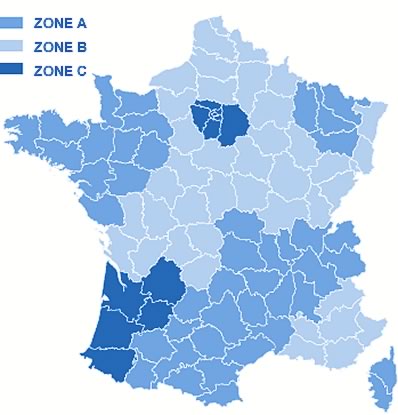
Welcome back! Here we go embarking on a new school year. During the holidays I decided to look up the holiday dates for next year. However, the French governments calendar wasn’t very clear so I decided to make an easy-to-understand calendar in English for you. This is the first place on the internet to have one! So here it is…  The school holidays in France depend on what zone you’re living in.

As you can see on the map, France is split into three zones. Zone A, Zone B and Zone C. Find your department on the map to see which zone it’s in and then look at the corresponding column of the table showing the holiday times below.

Zone A: Caen,  Clermont-Ferrand,  Grenoble,  Lyon,  Montpellier,  Nancy-Metz,  Nantes,  Rennes,  Toulouse.
Zone B: Aix-Marseille,  Amiens,  Besançon,  Dijon,  Lille,  Limoges,  Nice,  Orléans-Tours,  Poitiers,  Reims,  Rouen,  Strasbourg.
Zone C: Bordeaux,  Créteil,  Paris,  Versailles.

Holidays
Zone A
Zone B
Zone C
Back to school
Thurs 2 Sept 2010
Thurs 2 Sept 2010
Thurs 2 Sept 2010
All Saints
23 Oct – 4 Nov
23 Oct – 4 Nov
23 Oct – 4 Nov
Christmas
18 Dec ‘10 – 3 Jan ‘11
Winter Break
26 Feb – 14 Mar
19 Feb – 7 Mar
12 Feb – 28 Feb
Spring Break
23 Apr – 9 May
16 Apr – 2 May
9 Apr – 26 Apr
Summer Hols
2 Jul 2011
2 Jul 2011
2 Jul 2011
All holidays begin after classes and end on the mornings of the days indicated. Students who don’t have classes on Saturdays begin their holidays on Friday afternoon after class.

Click here to download a larger version
{Source: http://www.education.gouv.fr/} 

Article by The Editor

Saturday, June 12, 2010

2010 drawn to an end

Dear Readers,

This year has had it all, heavy snow, an announcement of a Lycée reform and something every French school year has, strikes! And yes, due to these many factors, some teachers are expecting students of 2nde to come in until the 2nd July 2010 so that they can complete teaching the program. The program that will not be there next year (see article on the Lycée reform). I hope all the students among my readers got what they wanted for next year like I did, however, I know that some new-comers (that is to say those who have been in France for less than three years) find it hard and often it’s a good decision to repeat the year. But here’s a quick re-cap on this years conseils. And the results have been a bit Greek this year…

Firstly, it seems that in my Lycée, S is quite popular and also seems quite easy to gain access to! With 51 students going into 1ère S for the school year 2010-2011 compared to a mere 36 going through to L and only enough students going through to STG to make up one class. Eleven will repeat 2nde. This however brought a question to mind, how is it possible? With 1ère S apparently “the hardest year to get into”, how is it that some 50% of the students in 2nde could have made it through to S without much of a struggle? So I did some research and unveiled a surprising and remarkable story. One of the 2nde students made it through to 1ère S with an average of only 6 in Chemistry! This must make a mockery of the entire “only the good students make it through to S” theory which, to start with, I didn’t for one minute believe. Don’t be fooled. No BAC is better than another. They all just specialise in different domains. L is for those who are good at languages and literature, S for those good at science and maths. Normally ES and STG are chosen if you’re looking to work for the social services, council etc. Generally speaking, you don’t pick a job in a laboratory if you like literature. The aim of the BAC’s is just to get you through Lycée and out the other side with the best result as possible. That’s why if you’re not good at maths, you pick L.


In the collège things have been equally strange and normal at the same time. With the brevets coming up, some collègiens will be taking the last few weeks off (not the 3èmes of course!). The 6èmes are on their days out for some schools and primary schools normally have a school trip around this time. Some teachers seem to be changing schools next year due to moving house. This could be as a result of the credit crunch and their downsizing… or the opposite!

And last but not least, to close the year, I would like to take this opportunity to thank all of the readers for your great, outstanding support (and sometimes criticism, however I encourage the latter to take place through email and not on forums as some of you have been practising it). According to the blog’s visitor statistics, the number of readers in the last 30 days alone has shot up by 2500%! And you’re actually reading which means so much! With some people spending 30 minutes of their time reading the articles from our archives. This year is drawing to a close and since March, the number of readers rose from 0 to some 500 some of which are returning! In addition, it’s not just France that’s logging on, readers from all over the world have been using The Lycée Times, from countries such as Germany, Italy, The UK, Ireland and recently Russia! This blog would be nothing without you so thank you so much and remember to come back after the rentrée 2010!
 
The blog will not be updated during the summer holidays, but it will remain online and the next post will be at the rentrée. Happy holidays to all and I wish you all the best for the rentrée 2010. See you in September!

Best Wishes,
The Editor

_______________________________

Just a reminder that you can now find The Lycée Times on Google. Just search for The Lycée Times and it’s the third or fourth one down, with the title being simply, “The Lycée Times”.
Or, bookmark us by pressing Ctrl+D on your keyboard!

Saturday, May 29, 2010

The conseil de classe. Find out what the teachers DON’T tell you!

Dear Readers,

If this is your first year of experience of the French schooling system and you’re not brain-dead yet, I would personally like to congratulate you. Well done, you’ve done it! It’s the end of the year!
Yes, the end of the year is forever nearing closer as we move into June and this means that the teachers will be having a meeting called the “Conseil de classe” (Class council) which is made up of your year head, class tutor and principle. All of these, plus your other teachers from all of the subjects will have an input into the verdict at the end of the term on whether you’ll be going into next year or not. There are, however, some things worth knowing that the teachers don’t tell you!

1. They might try to make you repeat
This is something to be wary of. The teachers can have the tendency just to go ahead with this things, regardless of your results “because you’re a foreign student”. Cruel, but so very unfortunately true! You mustn’t fall for this straight away. There are a couple of things to take into account first. Firstly, you should not repeat the year if your moyenne generale is higher than 10. Especially in collège. There are (and this is a fact) French students who go through to the following year with moyennes of 10 and foreign students who get kept back even if they have the same result. They’ll try to make it sound as if it will be “hell on earth the next year” and “that you must repeat because you won’t be capable” but really, if your moyenne generale is higher than 10, get out the cotton-wool!

2. Retiring teachers can help!
Ok, ok, I know this sounds silly but you’ll need all the help you can get. All of your teachers get a form in the shape of a table. What they must do is tick the “Yes” or “No” box as to whether you go through to the following year. If they want you to go through then they’ll tick “Yes” and vice versa. Retiring teachers, if they’re nice, can help you out by giving you a “Yes”. This was my case a couple of years ago. The week before the conseil de classe, my teacher who was retiring that year, approached me after class and asked would I like to go through to the following year. I said yes and she said that she would support that decision and try to make it like her “final act” in her schooling life, to get me what I wanted. But you have to have been well behaved during the year… That could help more!

3. Things to bear in mind before you go running off to repeat
Bear in mind that if you are in 2nde this year and you’re thinking about repeating, that there is the réforme du lycée next year. This means that you won’t be doing exactly the same things you did this year and you may not even have the same books! No-one knows! Even the teachers!

4. What the teachers never mention
The teachers will try to make you repeat and they will say that it will be too hard. Don't fall for it! In an interview with a French teacher, she said casually, that "we repeat all foreign students once they get to 3ème before going onto 2nde". So it's a cycle that they have in place and you should know by now what the French are like with their Administration departments etc.

I hope this advice has been helpful. I understand some of this may seem a little racist towards the French on my part, but I’m not. My best friend is French. It’s just the truth! Please leave your questions (and/or criticism!)  in the comments box below. You don’t need an account and you don’t need to log in. Just click on the text saying the number of comments, write your comment and press “Post Comment”.

Article by The Editor

Saturday, March 27, 2010

Brevet des Collèges - What's it actually for?

Dear Readers,

I have been asked this question so many times, having been through the process myself, everyone asks the one same question: "Is it important?". Well the answer is, not really! The Brevet is an exam you do when you are in 3ème. It's the French equivalent of GCSE's but it doesn't even need to be on your CV when you're looking for a job after school! Some people believe that this exam decides whether you get through to Lycée after 3ème. A woman who has a son in 3ème asked me earlier this week, "does the Brevet decide to let you though to Lycée?". After having been through the mangle of the Brevet and having spoken with my principal on the matter last year, our school principal claimed that your moyenne generale in 3ème decides whether you go through and not your result in the Brevet. In fact, this decision is already made a month before you even enter the exam hall. Our principal continued in saying that "the brevet is irrelevant". Your conseil de classe decides whether your moyenne generale is good enough to let you through in May. The Brevet is held normally during the second last week of school before the summer holidays in July. So don't get nervous going into your Brevet. The decision is already made and has been discussed between you, your parents and your teachers before you even pick up your pen in that exam hall.

It is, however a good idea to get a good a result as you can get just to prove to your teachers that a foreign student can pass the exam. It's also to allow you to have bragging rights for the next year... if you get a good note.

The Brevet Blancs are held throughout the year. Usually in January and another at some other point before the real thing. These are mock exams and usually much, much harder than the actual Brevet itself. Bear this in mind when talking to your principal if he brings up the matter in a meeting. It will prove to him that you aren't a fool and you're making a sensible decision after having done research.

I hope this has cleared up the brevet issue for all of you.

Article by The Editor

Saturday, March 20, 2010

Coefficients on tests

Dear Readers,

This week I will be explaining to you about coefficients on tests and exams because it can be quite confusing. It took me a while to get my head around it, but here it is.

In France, teachers have a habit of having coefficients on tests and exams. What this means, is that whatever note you get in a test, your result is put into your moyenne general depending the number of the coefficient of the test. 

For example, if you get 12/20 in a French test, with a coefficient of 2, then when your teacher goes to add that test to your moyenne generale, they will put it in twice:

(the brackets {} represent 1 test)

{14/20 (coeff.1)}, {9/20 (coeff.1)}, {17/20 (coeff.1)}, {12/20, 12/20 (coeff. 2)} 

After adding it up:

Moyenne: 12,8

Even though you've had one test where your note was 12, it gets put in twice because it was coefficient 2.

This can drag your notes down, so when the teacher says there'll be a test coming up, always remember to ask what coefficent it will be. Coefficient is the same word in French, so remember! If it's a high coefficient test, revise hard to get a good note, otherwise it may lower your moyenne at the end of the term!

Article by The Editor

Sunday, March 14, 2010

BACs and Lycée

Dear readers,

This week I will be talking breifly about Lycée and BACs.


I will start with the differences between Lycée and Collège. To start off with, in lycée you have a lot more freedom. During study hours, you are not made to sit in a room. Instead, you are free to spend time with your friends either around the school campus or around the town. This freedom is to be respected though. The CPE's (heads of the vie scolaire) will take it away from you if you go even slightly out of line when around the town. It's precious so take care of it!


Lycée does however require a lot more work and a lot of important choices. When moving into lycée, you have two choices. You can do a lycée générale course, which will bring you onto a BAC L, BAC S, BAC STG, BAC ES etc. Your BAC is the last exam you will do in lycée before going onto university if you choose to do so, so your BAC goes on your CV when applying for a job. On the other hand, you can opt for the lycée professionelle course which is basically business studies or training to go into catering etc. If you are planning on going onto university, it is not advised to choose this route, and also, when you come to apply for a job that requires a BAC other than the BAC Professionelle, you stand a much lower chance of getting that job. However, this is an advised BAC if you plan on entering the field of catering; on the other hand, it is not advised if you think you might change your mind later on, as it is virtually impossible to pass from lycée professionelle into lycée général once you have passed into 1ère. BACs are confusing, do not worry. It can take a while to get your head around them. For more information, go to www.onisep.fr.


Article by The Editor

Saturday, March 6, 2010

The French Education System - Collège


Dear readers,

The French education system, like so many others, has unique names for different school years and exams. In this, our first article, I will explain to you, in the easiest way I can, about the different years and I will tell you a bit about the subjects and exams to expect as you work your way through.

To start off, in France, they have 6ème, 5ème, 4ème and 3ème in collège, and 2nde, 1ère and Terminale in lycée. Collège is basically secondary school all the way up to your GCSEs (Britain) or Junior Cert (Ireland), of which the French equivalent is the Brevet des Collèges. After your Brevet, you move onto lycée and into 2nde.

After CM 2 (the last year of primary school), you go into 6ème which is also known as the "cycle d'adaptation". In this year, you will have many hours of your timetable taken up with subjects that you will not have the following year. These are called "les heures d'adaptation" which helps you to adapt to life in collège. Other subjects include music, art, technology (woodwork, metalwork, technical drawing), choir (optional) SVT (biology), and the Projet Personnalisé de Réussite Educative (PPRE) which helps students in difficulty with things such as reading and writing etc. This is advisable for any students who have recently moved over from a foreign country, but it's for all students in 6ème.

After 6ème, you move into the "cycle central" which is 5ème and then 4ème. In these years, you will no longer have the PPRE, but will keep art, choir etc. New subjects will include Latin (optional but can count towards your BAC) and Physics and Chemistry (one subject). In 5ème, you could be doing different workshops and group projects chosen between you and your teacher. Then when you move into 4ème, you'll need to start thinking about lycée and what job you would like to do when you leave school. Part of the 4ème curriculum includes a week of "work experience" where you'll get to see how enterprises work. This includes day trips etc.

After 4ème, you'll be moving onto your last year at collège. This is the year where, if in Britain, all the girls would cry come June... That's not the case in France! 3ème is known as the "cycle d'orientation" where you have to decide what BAC you want to go on to do, in order to decide whether lycée générale or professionelle is best for you. The best way to do this is to pick a job or a field that you'd be happy working in, see what BAC you would need, then see which course you have to do to get access to that BAC. 3ème is not worth repeating if your averages are higher than 10. The teachers will try to make you repeat and they will say that it will be too hard. Don't fall for it! In an interview with a french teacher, she said casually, that "we repeat all foreign students once they get to 3ème before going onto 2nde". So it's a cycle that they have in place. If your averages are under 10, then a repeat of 3ème is advised. If not, ignore the teachers, tell them you want to pass onto lycée straight away, and if they still persist in saying that a repeat of the year is what they want you to do, you can appeal to the school's "conseil de classe" (class council) which is made up of your year head, class tutor and principal. Making an appeal could force them to put you through. Remember, the teachers are not your friends, they don't want you to do your best in France, and they just want to get you through the system and out the other side with a BAC. It might not even be a BAC that allows you to do what you want to do, so do what you want to do and don't listen to them unless your average is under 10.
Another thing that comes up in 3ème is the Brevet. This cannot determine whether you go onto lycée or not because you do the Brevet after that decision has been made. Throughout the year, you'll do two or three Brevet Blancs. A Brevet Blanc is a mock exam which prepares you for the real thing in June. Brevet Blancs are also notoriously harder than the real Brevet, however, the Brevet Blancs are easily noted and they won't go too hard on you. If your notes are bad for the Brevet Blancs, a lot of work needs to be put in in order to prepare yourself for the real thing.

Article by The Editor